Friday, May 04, 2007

Shrewsbury Cakes from Shropshire


Much of my information about Shrewsbury cakes/biscuits has come from ‘The Taste of Britain’, by Laura Mason and Catherine Brown. For anyone with an interest in British foods and ingredients I recommend this book. The contents cover the produce of each region – vegetables, fruit, livestock and dairy products; and also documents traditional dishes, describing their ingredients (although no recipes are supplied), physical appearance (colour, size, weight) and their history. Brown and Mason originally drew together all of this information for an Europe-wide project that aimed to record traditional ingredients and dishes that are still grown, farmed or in production. It is therefore not an exhaustive list of traditional foods, but the book is incredibly impressive in both its breadth and its scholarship. It is also extremely readable and inspiring, making one want to go on a nationwide tasting spree.

According to Mason & Brown, Shrewsbury cakes (or biscuits) were first documented in the 1500s. The ingredients used at this time are unknown, but the cakes were renowned for their texture, being crisp and brittle. A couple of centuries later the Restoration playwright William Congreve used Shrewsbury cakes as a metaphor (“as short as a Shrewsbury cake”) within his play of 1700, ‘The Way of the World’. Another writer helped to popularise the cakes in the 19th century, . Richard Harris Barham writing as Thomas Ingoldsby penned a tale of ‘Bloudie Jacke of Shrewsberrie. The Shropshire Bluebeard - A Legend of the Proud Salopians’ (Salop is an abbreviation for the county of Shropshire). In this 1840 poem Shrewsbury cakes are attributed to Mr Pailin (“Oh, Pailin! Prince of cake-compounders! the mouth liquefies at thy very name”). If Mr. Pailin was a real person or not has not has as far I can tell been established, although a plaque on an old shop near to Shrewsbury Castle states that "This shop occupies the site of a building where Palin first made the unique Shrewsbury cakes to his original recipe in the year 1760” (alongside a quote from ‘Thomas Ingoldsby’ of 1840), and Mason and Brown write that a Miss Hill, daughter to a confectioner of the town, may have married a Mr. Palin(Pailin). Whether he was fact or fiction, Mr. Pailin's name was taken by a manufacturer, Thomas Plimmer & Sons in the town, who registered as a trademark the name ‘Pailin’s Original Shrewsbury Cakes’. Production up until the Second World War was by Phillip’s Stores Limited. Sadly, due to the rationing of key ingredients, in particular butter, the manufacture of the biscuits then finished. If anyone knows of a commercial manufacturer in the town today, please let me know.

According to ‘The Taste of Britain” the earliest written recipe for the cakes is in Eliza Smith’s ‘The Compleat Housewife’ in 1728. Ms. Smith’s recipe is for a sweet biscuit with nutmeg and cinnamon. However, my internet rummaging came up with an earlier recipe, and Florence White’s ‘Good Things in England’ (1932) has a recipe that may also predate Eliza Smith’s book. The recipe in ‘Good Things…’ come from a Colonel Plomer of Shrewsbury, and he supplied it from a family receipt (recipe) book kept from 1630 to 1750. The Plomer family recipe flavours the biscuits with caraway seeds, nutmeg, sack (or sherry) and rosewater.

The second, older, recipe I found is in Hannah Woolley’s ‘The Queen-like Closet or Rich Cabinet’, published in 1672. She flavoured her biscuits with cinnamon and rosewater only.

I am going to follow Colonel Plomer’s recipe, and not only because he has a fine name. I do like the flavour of both caraway seeds and rosewater, so I am happy to try them out in combination in one biscuit. The Colonel’s recipe works with one pound each of flour, butter and sugar. This must make up a rather large quantity of mixture, so I shall halve the recipe.

225g plain flour
225g caster sugar
225g unsalted butter
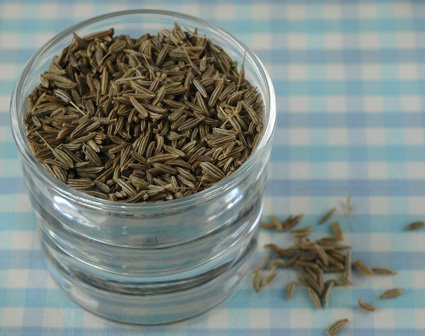
5g caraway seeds
1/2 tsp ground nutmeg
1 egg, beaten
1 and 1/2 tbsp sherry (I only used the measure of rosewater as the mix was so wet)
1 and 1/2 tbsp rosewater

1. Preheat oven to 170C/325F/Gas 3. Prepare two large baking sheets.
2. Rub the butter into the flour.
3. Add the spices to the sugar and then tip the whole into the flour and butter mixture.
4. Add the beaten egg, and also the rosewater. I did this ahead of adding sherry, and found the mixture already to be too wet for rolling out successfully. I had to add more flour and omit the sherry altogether. I then chilled the mixture, covered, in the fridge. I left mine overnight, as I had to return to my little man, but 30 minutes would probably do it.
5. Roll out the mixture on a floured work surface. This still might take a bit of doing as the mixture is still a little sticky. Using circular fluted cutters to press out your biscuits and pop onto baking sheets.
6. Bake for approximately 20 minutes, but keep an eye on them. With all that butter and sugar disaster could quickly strike should one go off for a nice cup of tea.
7. Leave biscuits to cool for a few minutes before sliding them onto a wire cooling rack.


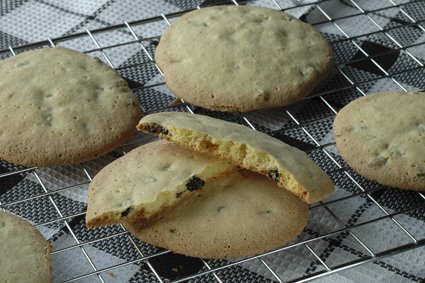
The biscuits were very sweet and buttery, as you might well expect considering the proportions of ingredients. The rosewater added to this sweetness, but for me the nutmeg was completely lost. Caraway seeds have a distinctive flavour and they did manage to stand up to the rest of the biscuit, and retain a voice of their own. The biscuits had a rather nice denseness and the promised brittleness manifested itself in a good clean ‘snap’. That all said, I would next time round look at reducing the amount of butter (made the mixture difficult to work) and the sugar (I like my own teeth), perhaps adapting a more standard shortbread recipe as these biscuits are a form of shortbread.

I’ve had a request for an up-to-date picture of Ellis. Just the one, but I only need to be asked once. Thank-you for indulging me my proud mumness! Here he is – 9 1/2 weeks young.

Wednesday, April 11, 2007

Easter Treat


For my first posting after my young man’s arrival, I am going to keep things fairly simple. I am also writing under a tut-tutting of disapproval from my husband, not due to neglection of the little ‘un, but because I have accepted a commercial freebie in the form of a chocolate Easter egg from Hotel Chocolat. Now I was quite flattered to have a company contact me and offer to send me a luxurious Easter egg gratis, in return for my reviewing said item on my blog. Mainly because it suggested that somebody believed the readership of my site extends beyond me, and my mum and dad. I couldn’t see too large a dilemma, or too fatal a blow to my integrity (do let me know if you disagree!), after all I might try the egg and promptly demand it be scrambled. Hotel Chocolat presumably banked on my taste buds coinciding with their own taste values, but a review can go either way, and an Easter egg is a sweet of two halves…

I knew of Hotel Chocolat, but had never before eaten any of their goodies. Their leaflets fall from the Sunday papers from time to time, and I have previously got as far as going for a drool on their website. I once idly thought about buying myself a subscription to their Chocolate Tasting Club – such a fabulous idea, to receive regular supplies of top-notch chocs by post. Just as one polishes off one box, there goes the doorbell with the postman bearing a new box. Fab. There were two reasons why I didn’t sign up. 1. The idea of buying oneself a chocolate subscription just seemed a little too self-indulgent, even for me. It would be a fabulous gift. 2. I would have had to share the chocolates with my husband, unless I could come up with a subterfuge that would result in the chocolates being delivered to a neutral third party (work would have been too risky). Not that I don’t like to share with my husband, but when it comes to chocolate sometimes a firm line needs to be drawn.

So, to the egg. I should say at this point that I have made chocolate eggs in the past, so perhaps I do have some ‘expert’ knowledge that I can call upon for this important egg assessment. One year I made small solid chocolate eggs, by emptying the contents of a hen’s egg, and using the shell as a mould. Nice and simple. Then last Spring I went on a chocolate workshop at Leiths School of Food and Wine in London. During this day I learnt how to: 1. make a terrible sticky mess using chocolate and as many utensils as I could lay my hands on; 2. make some delicious truffles which resembled other brown objects not generally perceived as delicacies; 3. how to temper chocolate and create an Easter egg using a mould of two halves, and using a brush and melted chocolate to build up the shell. I recreated the moulded egg at home for my husband (you see, I can be generous sometimes), and ended up with an egg that needed a JCB to crack it open. The Hotel Chocolat egg claimed to have an extra thick shell, so I looked forward to seeing if it could compete with the bad boy I made.

I had been sent a British Classics egg. A 72% dark chocolate shell embedded with small fragments of cinder toffee, and filled with a selection of chocolate sweets chosen to be nostalgic but in a sophisticated way (a chocolate fondant mouse was included rather than a sugar one). The egg was carefully packaged in a very grown-up, although rather understated (I prefer a bit more campness) looking, black box, and this box travelled within another to arrive safely unbroken at my home. Each half of the egg is wrapped separately in foil and the chocolate goodies are in small bags within each half. A visit to the Hotel Chocolat website reassures me that the plastic element of their packaging will soon be replaced by a biodegradable alternative. However, the part that disappeared first in my home was the edible mouse. Cheeky devil - one minute on the table, the next nowhere to be seen. Chomp chomp.


I sampled first the sweets. Large discs of stem ginger encased in chocolate. Chocolate covered cinder toffee (think v.posh Crunchie bars, but don't tell that to Hotel Chocolat). Dipped brazil nuts (brazil nuts are so GOOD for one, aren't they?). Marzipan with orange in a chocolate overcoat - very nice, but I could have readily munched the marzipan naked as I love the stuff (take that how you will). Sorry, don't know what happened to the mouse, but it was milk chocolate and filled with smooth creamy praline. As to the the egg. Well, I was impressed to discover that this egg did exactly what it said on the box. It did indeed have a extra thick shell, almost immodestly so. If the egg had been served up whole instead of in two pieces, I think it would have taken some serious heavy tools to force entry. Instead I gave my hands and teeth a good work-out.

So if I wasn't enjoying a free treat, would I be prepared to pay £18 for the egg? Do you know, I believe I would. It is definitely an egg to eat slowly and enjoy, rather than one that you end up bolting down in the time it takes to boil a you-know-what (don't tell me I'm the only one capable of such naughty gluttony?). For me dark chocolate is more of an after-dinner taste, perhaps with a chilled glass of something sweet (and we're not talking chocolate milk). This egg should last me at least a week of after-dinners, and that may also allow for sharing!


P.S. I had high hopes to make an Easter egg offering of my own to conclude this post with. I had decided to make some marzipan, form an egg, and then present it beautifully coloured and gilded. Unfortunately the result looked more like an Easter potato, and not half as appetising as a painted golden spud. It is better therefore that I sign off with an image of one of my little solid chocolate eggs (prepared earlier), so that I can continue to hold my head up high and wish you (a belated) Happy Easter.

Saturday, March 17, 2007

Truly Scrumptious


I have had a busy old time of it since my last posting. At the end of the second week of February, we at last were able to move to our new home in Hitchin. Two weeks after that, on the 25th of February, the really important event we had been looking forward to happened and we had a lovely little boy - Ellis Lloyd Graham. More delicious than the most delicious kitchen creation.
Thank you to everyone who has left comments on my site over the last month and a half. I have only just been able to log on and view them. Thanks to the efficiency of BT we have been without an internet connection since the beginning of February, until the middle of last week. I am hoping that in between topping up Master Ellis' fliud intake, and catching up on the odd bit of shut-eye, I will be able to continue on my baking quest (and maintain the yummy as well as the mummy).

Wednesday, January 31, 2007

Honey Tea Bread


Motherhood shortly pending, last Friday was my final day at work. I am lucky enough to be able to take twelve months' maternity leave, and although currently the year stretches out ahead of me in a seemingly endless way, I expect that come the big arrival time will start to fly.

I was given a lovely send-off by my work friends, some of whom I have only had the pleasure of working with for a short time, but we had all bonded over coffee/tea and cake of a morning. Coffee and cake for one is never as fun (although it does mean more cake for me), so this posting I would like to write as a thank-you to the team and as a virtual coffee/tea-break for them to share in.

One of the presents I was given was a cup and saucer set, designed by someone who obviously also enjoys the finer, simple pleasures of life. The saucer has space on it for a slice of cake to accompany whatever warm beverage you are most partial to. What a work of genius.


I was also given a rather fine and cleverly designed mixing bowl. This is ergonomically shaped so that it sits both into the crook of the arm, and securely on the worktop by means of an angled base. Gary Rhodes has put his name to the range, and it is nice to think of Gary waking in the middle of the night with the idea fresh in his head, but possibly someone else did the night-time inspiration on his behalf. We shall never know…


So taking the lead from these two gifts, and also the long-standing tradition of mid-morning and mid-afternoon social refuelling, I have baked a suitable cake to accompany a pot of tea; or if you need a shot of something stronger pre-lunch, then a pot of coffee.

Across Britain home-bakers have created a wide gamut of cakes and breads well suited to accompany a nice cup of tea. I say tea, because historically we are a nation of tea drinkers. Coffee had its heyday here in the late 17th century, mainly amongst the wealthy and intellectual; but once tax on tea was reduced the coffee pot was drained and rarely refilled. Coffee remained a European preference and not an English taste, until we saw the introduction here of Italian-style coffee bars and then the emergence of the American coffee chain that I need not name; but this has been a slow percolation over the last fifty years or so. Tea is the drink of the people, a social activity as much as a refreshment. What would this country be without tea and cake; tea rooms; tea breaks; tea stops; flasks of tea; tea shops; tea and biscuits; tea dances; tea and sympathy; High Tea and Afternoon Tea? One can drink it by oneself, but a pot of tea is so much nicer placed in the middle of a table surrounded by other folk.

Tea breads come in as many different forms as there are ways of taking tea. Sweetened breads are the pre-raising agent equivalent of cakes, and the older forms of tea bread are yeast-raised doughs – think of such treats as Hot Cross buns, Chelsea buns and Saffron cake. With the introduction of baking powders in the mid-19th century, tea breads and cakes could take a different form, and could become as light as a Victoria sponge cake, or dense and delicious like Madeira cake. From these examples you will see that there are few cakes not suited to accompany a nice cuppa.

Jane Grigson gives a recipe for Fruit Tea Loaf in English Food. Ms. Grigson states that such cakes were particularly popular in Yorkshire and the North of England, where they were served at High Tea and at post-funeral get-togethers (wakes). High Tea is a Northern/Scottish meal, served early Sunday evening prior to church. It is a proper family sit-down, with copious amounts of tea and home-baked goodies. Jane also mentions that tea loaves are all the better for a few days keeping before eating – something I usually struggle with in my greed, but that I did manage to achieve this time (a big pat on the back to me).

My recipe is another take on the tea bread idea, for it makes use of tea as an ingredient – a key element in fact – the tea both rehydrates the dried fruits in the cake, and adds a depth of flavour. The recipe comes from the website of the Honey Association. I thought I would get a plug in for them ahead of National Honey Week, which runs from the 12th to the 18th of February. The recipe uses honey instead of refined sugar. As honey has a more distinct flavour than sugar, I was interested to see if I could still taste it in the finished cake – or would the tea flavour dominate?

I used Twinings Afternoon Tea in my cake. This may cause a shudder amongst tea-drinkers of a sensitive disposition, but I do have to confess that I used tea bags. We are coffee drinkers at home, so I swiped a few bags from the cupboard at work (tea tastes are far classier there). Twinings Afternoon Tea is a blend of Kenyan, Assam and Ceylon teas. It is described as having a character being 'bright and refreshing'. Well, I'm pleased to make your acquaintance.

The honey also has a link with my recently departed from company. An ex-fellow worker’s father has his own bees, and the honey I used in the cake is from him. The honey was produced by busy bees in Frome, Somerset. Which by coincidence is also the county where the butter I used for slice spreading was produced.


So I soaked my fruit, made my cake and then left it to its own devices for a few days, tightly swaddled in kitchen foil. The grand unwrapping came when I had the pleasure of having my mum here for the day, and we were able to sit down and enjoy tea and cake together. The cake was lovely and moist, and after some ladylike sniffing, we judged that there seemed to be a hint of honey scent to the cake. I couldn’t really determine a flavour of honey, nor of tea, but it was pleasant enough taste-wise, although I think it could have benefited from having a little more definite flavour.


My mum brought with her a box of homemade flapjacks, so I can now look forward to several morning-coffee ‘breaks’ with a flapjack at the side of my cup. It is a tough job not working.

Sunday, January 14, 2007

Coventry Godcakes


Godcakes seem to be peculiar to Coventry, although similar pastries known as God's Kitchels (or Kichels) have an association with the Suffolk area (according to Florence White). Both Godcakes and God's Kitchels were handed out at the beginning of the year (or Easter), by godparents to godchildren. The idea was that when a godchild approached their godparent to request a blessing, they would come away with a double-whammy - a blessing and a cake. A fair deal for the godchild, I think. Many internet sources claim that Chaucer mentioned Godcakes, but from a speed through online transcriptions it appears that it is Godde's Kichels that are referred to - see The Sompnour's Tale (set in Holderness, Yorkshire).

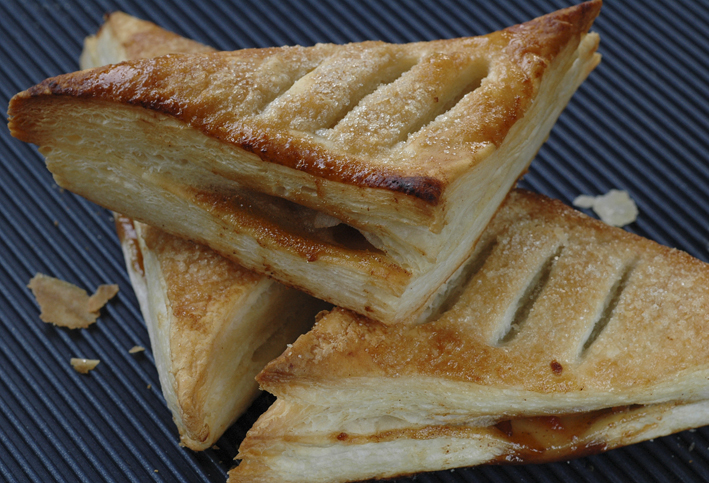
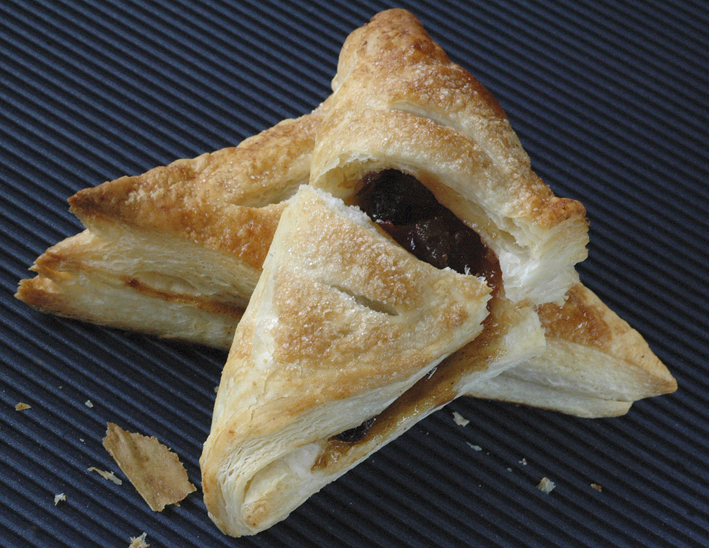
From a glance at the photo at the head of this posting, many pastry fans will see that Godcakes bear more than a passing resemblance to jam puffs; and to be fair, aside from the filling they are identical. Jam puffs are known apparently known in the bakery trade as 'Coventrys', by reason of their descent from the Coventry Godcake. Godcakes are filled with mincemeat rather than fruit/jam.

Historically, Godcakes ranged in size and price, depending on the pocket and generosity of the godparent. The triangular shape, along with the three slashes in the top of the pastry, has led to speculation that the cakes were representative of the Trinity, but this is an assumption rather than a fact. Dorothy Hartley mentions this association with the Trinity, but says 'the origin is obscure'.

Godcakes are very easy for the heavily pregnant and time-poor cook to assemble. They are also a good way of using up any leftover Christmas mincemeat. Some recipes call for an addition of rum to the mincemeat; and if you fancy slipping a measure in, then please do so. If you purchase a pack of puff-pastry, then this recipe couldn't be simpler. Recipes and methods vary very little between sources - both Florence White and Dorothy Hartley carry recipes, but see also Town & Country Fare & Fable, and English Teatime Recipes.

Puff pastry
Mincemeat
Dash of rum (optional)
1 egg white and some caster sugar to finish

1. Preheat oven to 220C/425F/Gas mark 7.
2. Roll out the pastry on a lightly floured surface.
3. Methods divulge at this point, so you can either cut out squares (4 inches per side), and then cut the squares into triangles; or leave the squares uncut. It depends whether you want to make your Godcake using two triangles pressed together, or using a square folded diagonally. I tried both ways to see what worked/looked best.
4. Place a teaspoonful of mincemeat in the middle of your pastry shape. Don't be too generous, otherwise the mincemeat will squidge out when you press the pastry together. I found that if the quantity looked a little mean in my eyes, then it was sufficient.
5. Moisten the edges of the pastry with a little water, and press either the second pastry triangle on top, or fold the other half of the square over to form a triangle. Press the edges of the triangle to form a seal/eject mincemeat all over the worktop.
6. Cut three slashes in the top of your Godcakes. Brush with egg white and sprinkle with sugar.
7. Bake for approx. 15 minutes, or until golden and well puffed up.
8. Cool on wire rack.


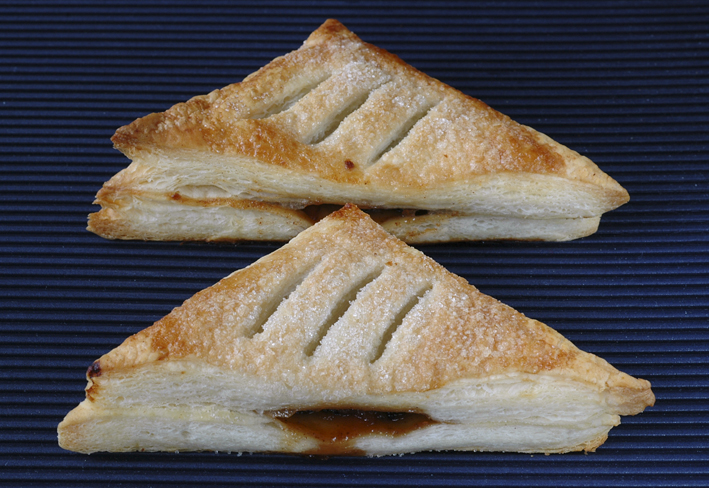
The two triangles method produced a very neat looking cake - should this matter to you.


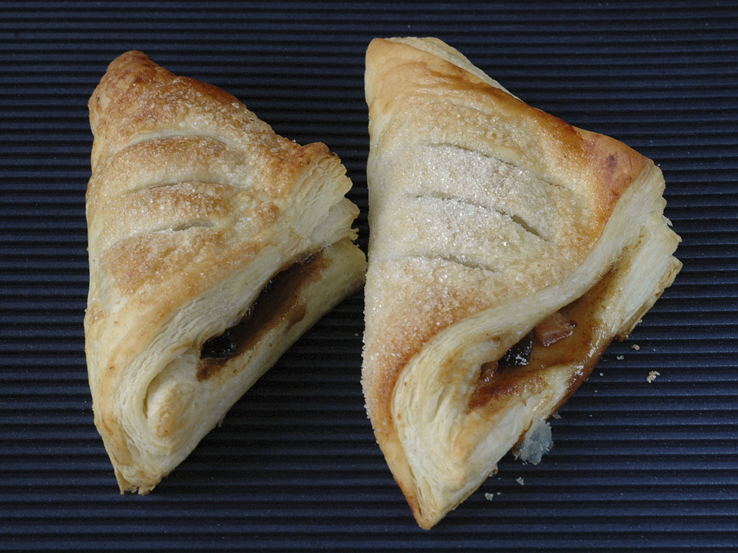
The folded square method produced a cake that distorted a little in the baking, but I rather like the way that the puffed pastry has an emphatic fold - like a big pastry duvet...

Needless to say, regardless of method, both sets of cakes were consumed very quickly, without either consulting godparents or considering the needs of those requiring blessings. Bless us.


One last thought on Godcakes. For Christmas my brother gave me a fantastic book called 'England in Particular', that is filled to the rafters with interesting lore and history on all aspects of England. Godcakes, according to this book, have a second meaning. A god cake (or jam puff) is a Warwickshire name for the triangle of grass at a road junction - created as the road splits to go left and right. I thought that this was probably a lost expression, but when researching Godcakes on google, I was extremely heartened to come across a note in July 2004 Parish Council minutes for Balsall, Warwickshire (not far outside Coventry), that read:

15.8 The Footpaths and Highways Committee will consider the request to re-plant the Godcake in Oldwich Lane.

Please no-one write and tell me that this doesn't refer to a large jam puff at a crossroads.

Sunday, December 03, 2006

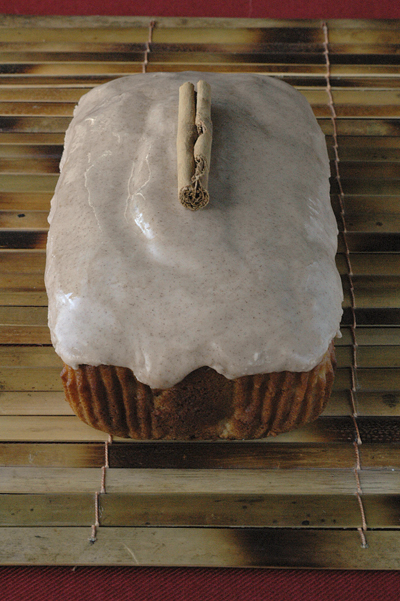
Apple Gingerbread with Cinnamon Icing


Well, I'm afraid it has been a little while since my last post. Of late it has been difficult to find a weekend with enough time free to research, write, bake and photograph, but I am aware that my opportunities for doing so may decrease further in the near future. Many weekends recently have been taken up with house-selling and house-purchasing activities; or we have been out and about test driving pushchairs or cot viewing. We are expecting our first baby in February, and all spare time seems to be focused on him/her, and relocating to Hertfordshire ahead of the big event (and possibly before Christmas). But today, I am making cake whilst the sun shines, and I have been inspired by the new county that I hope to be living in soon.

Hertfordshire is one of southern England's apple growing counties. The first commerical plantings of Cox's Orange Pippins were established there in the 1860s. The crisp, sweet and sharp, russetted dessert apple became one of the most popular varieties and is widely available today. I had bought a quantity of Cox's and Bramley apples with which to make some mincemeat, and having spent a morning in the kitchen inhaling the fug of warm spices, cider and the rich sweetness of cooked apples, I felt ready to bake a little something for immediate consumption (don't you think that 'fug' is the perfect word for cider related activities?).

My recipe is from the book 'Farmhouse Fare' by Countrywise Books. First published in 1973, it is a collection of country recipes gathered by the readers of 'Farmers Weekly' magazine. The recipes had been collected by the magazine since its launch in 1934; generally from the wives and daughters of farmers - those stalwart ladies at the heart of rural communities, who make good use of locally available ingredients, and produce from their own fields and livestock. My particular recipe was sent in by a Miss Mary MacDonald of Inverness-shire (Scotland), but it struck me as being the perfect recipe to capture something of the combination of apples, sweetness and spice that I had scented the house with whilst simmering my apple mincemeat.


225g cooking apples (or strong flavoured dessert apples, such as Cox's Orange Pippins)
75g Demerara sugar
112g golden syrup
75g butter
175g self-raising flour
1 teaspoon ground ginger
1/4 teaspoon ground cloves
1 egg

For the icing:
175g icing sugar
2-3 dessertspoons of warm water
1 level teaspoon ground cinnamon

1. Preheat the oven to 180C/350F/Gas mark 4.
2. Grease and line an square or oblong cake tin (I used a loaf tin).
3. Peel and slice the apples, and put into a pan with 1 dessertspoon of sugar, and enough water to stop them from burning.
4. Stew gently until tender. Mash up and leave to cool.
5. Put the golden syrup, butter and the remainder of the sugar, into a pan and warm over a low heat until the sugar has dissolved. Leave to cool.
6. Sift the flour and the spices into a large basin.
7. Whisk the egg in a smaller bowl, add the cooled syrup mixture and continue to whisk until well mixed.
8. Add to the flour, along with the apple pulp. Stir well and then turn into prepared tin.
9. Bake for about half an hour.
10. Allow to cool a little before turning out of the tin. When fully cooled, prepare icing.
11. Sieve icing sugar and cinnamon into a bowl.
12. Mix with enough water to form a thick coating consistency.
13. Spread over the top of the cake and leave to set.

The gingerbread was a pale sponge, rippled with the flesh of the cooked apples. Lovely and moist. I was concerned that the quantity of cinnamon in the icing might be too tongue numbing, but it was perfect. Icing sugar is so saccharine, that the cinnamon had to fight hard to match the sweetness. The spiced icing complemented the cake extremely well, and added an extra flavour to the whole. This could be a nice alternative to the heavy fruit cakes served at Christmas time, perhaps with the addition of a handful of raisins. Plastic Santa is optional.

Tuesday, November 07, 2006

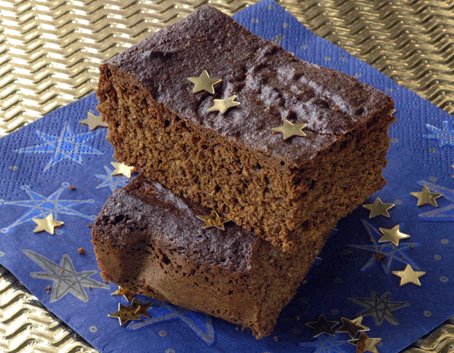
Holywake Bake Cake


Ginger, long a popular flavouring in British cookery, was just one of the smaller things that we have the Romans to thank for first bringing to our shores. As an ingredient imported into the kingdom, for most people it was not an everyday taste. Thus it was a flavour enjoyed at festivals and feasts - fairings were ginger biscuits, and also popular at social occasions were gingerbreads or parkin.

In the bad old days before telly, any excuse for a bit of time off work, or for a pint or two of strong beer, was an opportunity to be seized (so things haven't changed all that much really). Unfortunately, this meant that less cheerful get-togethers, for reasons such as a public hanging or burning, were also a chance for a holiday, a slice of cake and a jug of ale. 'Holywake' is a 17th century word (in use in the Cotswolds) for 'bonfire'; more specifically meaning a bonfire lit to extinguish heretics. Holywake Bake was, according to June Lewis in 'The Cotswold Cook Book', a cake cooked and sold at such unholy gatherings. To my mind, the inclusion of oatmeal in this recipe makes it a Northern treat, as oats grow best in the Borders counties and Scotland. Oatmeal is a key ingredient in parkin (a type of gingerbread cake), which itself has an association with November the 5th. I decided to have a go at baking Holywake Bake Cake because I thought it interesting to find a bonfire story alternative to the well-known tale commemorated with thanksgiving explosions at this time of year. Sorry not to come up with something a little more cheery!

175g self-raising flour
50g fine oatmeal
1 1/2 teaspoons of bicarbonate of soda
1 level tablespoon ground ginger
110g raisins (if liked)
2 tablespoons of golden syrup
2 tablespoons of black treacle
75g unsalted butter
75g brown sugar
1 egg, beaten
(also on June's ingredients list was 1/4 pint of milk, but this was omitted from the method - add a little milk to the mixture if you think it looks dry)

1. Preheat oven to 170C/325F/Gas 3. Grease and line a 10" by 7" tin.
2. In a large bowl stir together the flour, oatmeal, ginger, raisins (I excluded these) and bicarbonate of soda.
3. Put the syrup, treacle, butter and sugar into a small saucepan and melt over a low heat. Stir well to blend.
4. As soon as the above mixture has melted, pour into the dry ingredients and mix.
5. Add the egg and beat well. Add some milk now if you think it necessary - I didn't because I thought the mix looked OK, but the resulting cake could perhaps have benefited from it.
6. Pour into prepared tin and pop in the oven. Cake should take about an hour to bake.
7. Allow to cool in the tin; then turn out and cut into (12ish) squares.


I followed June's suggestion and made this a few days ahead of November the 5th; the cake would grow moist and sticky if it were to be left in a tin for a short time. This is usually sound advice with gingerbreads, but this time round I didn't find that the cake improved any. In fact I was a little disappointed by it. Maybe that errant 1/4 pint of milk would have made all the difference, although I have found plenty of other gingerbread recipes that don't call for any extra moisture. Best consumed with a large mug of something wet and warming.

Sunday, October 22, 2006

Rock Cakes & Biscuits


When poorly advised persons think of British baking, it may well be that monstrously hard rock cakes, rejected by even the dog, are what such folk think of. The epitome of a lack of basic skill and care in the baking department. Rock cakes, admittedly, do have a bad reputation, and their title does make for easy mocking. However, the name is supposed to be for their appearance, NOT their solidity. I think that rock cakes also suffer from being seen as old-fashioned. One can imagine them on the station tearoom counter, under a glass dome, in the film 'Brief Encounter'. But think, this should lend them an air of illicit pleasure, should it not? When I mentioned to friends that I was planning to bake rock cakes, the common response was, "I remember making those at school." Good old domestic science - teaching us the skills for modern life. So why did we not grow up to bake rock cakes on a regular basis? Did we become sidetracked by chocolate brownies, American muffins and cookies? Or was it simply that rock cakes are, whatever the skill of the baker, a second rate cake?

Rock cakes were a ubiquitous feature of school fetes, church teas, railway refreshments etc. They don't have a specific geographic origination, and the OUP 'A-Z of Food' credits Mrs Beeton with the earliest documented recipe for them. Mrs Beeton's orignal 'Household Management' was published in 1861 Her recipe (no. 1747) is for 'Rock Biscuits' rather than cakes. I don't have a copy of 'Household Management' (seem to manage OK under my own rules, thanks), so I used the recipe from this website.

Now, at first glance I was a little horrified at the proportions of sugar to flour, and the large number of eggs involved. I decided to half the recipe. A wise decision it turned out. I had a lovely time whisking the eggs to form a good thick froth, and then adding the sugar gradually, and then the flour. It was at this point I could see an obvious flaw to the recipe - what I had in my bowl was a batter not a dough. It looked far too runny to be able to form into 'rocky' looking biscuits. I added some more flour, but then thought that if I am trying a recipe from the original context, then I should follow it to see how it turns out. So I added a couple of handfuls of currants, and then spooned some mixture onto a baking sheet. Mrs Beeton's instructions state that you should use a fork to make the mixture (she calls it a dough) look as rough as possible. Sorry Isabella, but this just was not possible. Baking sheet number one went into the oven, and I tipped more flour into my bowl (lost track of quantities by this point), and I mixed in enough to bring the mixture together into a more dough-like consistency. By this point I was concerned that I was undoing all my good whisking work, and I decided to spoon out the mixture, roughen surface with a fork, and stick baking sheet number two into the oven.

Neither sets of biscuits looked quite how I imagined that they would.

Baking sheet no. 1


Baking sheet no. 2

Unfortunately, nor were they good to eat. Dry, hard and despite all the sugar and eggs, very bland. Sorry Mrs B., but these biscuits did not rock.

So I turned to a cookbook published in 1948, just three years after 'Brief Encounter' was first screened. I felt confident that by this date, rock cakes had evolved into a more edible proposition.

Orange Rock Cakes (from Elizabeth Craig's 'Economical Cookery')

225g flour
2 teaspoons baking powder
1 egg - beaten well
75g fine sugar
75g butter or margarine
Grated rind and juice of 1 orange
25g candied peel - finely chopped

1. Preheat oven to 180C/350F/Gas 4.
2. Prepare baking sheets.
3. Sift the flour and baking powder into a basin.
4. Rub in the fat.
5. Stir in the sugar, orange rind and juice, candied peel, and beaten egg.
6. Mix to a very stiff dough, then with two forks take pieces the size of a walnut and place a little apart on the baking sheets.
7. Bake for 10-15 minutes until golden.


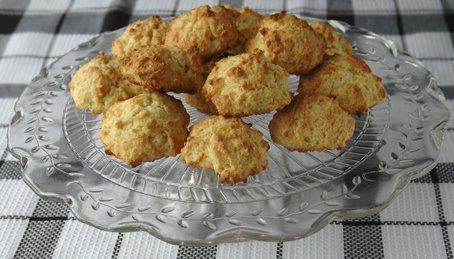
Success! Not only did the consistency of the dough prior to baking look right, but the finished cakes were golden and had a good cragginess to them. Each cake made a brief encounter with my plate before disappearing. Texturewise they were pretty similar to a scone, and the hint of orange was a nice touch. They were good the day of baking, but not bad a day later. Cakes/buns of this type can always be revived by the spreading of a decent bit of butter. Time for a rock cake renaissance I think.

Sunday, October 08, 2006

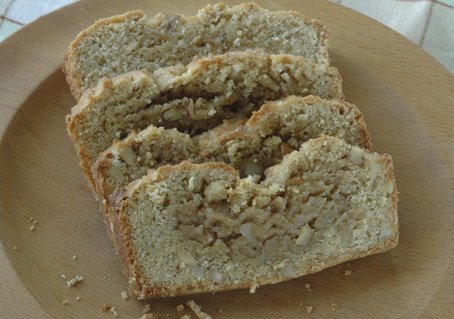
Kentish Cobnut Cake


...try saying that with your mouth full.

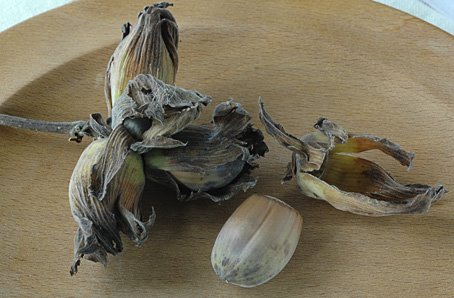
A cobnut is a type of hazelnut. The Kentish Cob variety, is ,however, not a hazelnut but a filbert - a slightly different species - according to the Oxford Companion to Food and the Oxford A-Z of Food and Drink (see also here. However, the websites of the Kentish Cobnut Association and www.cobnuts.co.uk, both state that Kentish Cobs are hazelnuts. If you know the definite answer please do let me know! Cobs take their name from the Old English 'cop' which meant head or 'cobbe' which meant any round object. The same descriptive word was also used for the cob loaf (a type of bread). Cobnuts were used as a predecessor to conkers in a similiar game called 'coblenut' (bet those 16th century schoolchildren didn't have to worry about Health & Safety leglislation).


A Mr. Lambert first cultivated the Kentish Cob in Kent in 1830, although other varieties of filbert and hazelnut were also planted commerically throughout the county and had been since the late 18th century. In Kent the orchards where the cob/filbert trees are grown are referred to as 'plats'. The harvesting of the nuts was traditionally carried out by itinerant pickers (just as the hops of Kent drew Londoners out to the countryside to earn some extra money); whether this is still the case I don't know, as the cultivation of cobs is carried out on a lesser scale now than in the early 20th century (7,325 acres pre 1914, and only 200-300 acres today). The first picking of the season is carried out in August, when the nuts are still very green and 'wet'. The second picking is about a month later, when the nuts have dried and ripened a little. A final sweep of the plats is done later to harvest anything still left on the trees. Both the green and the ripened nuts can be eaten, and at each stage the nuts can be roasted to enhance their flavour.

How to roast cobnuts (from the website of the Kentish Cobnut Association):

Crack and shell them, then cook them on tinfoil or a baking tray in an oven heated to about 150°C, 300°F, Gas Mark 2, for an hour or so; the cooking time depends on how ripe and how dry they are. First they become soft, but do not remove them until they have hardened, but have not blackened. They can also be cooked in a microwave oven; 4 oz of kernels will typically take 6 minutes on high.


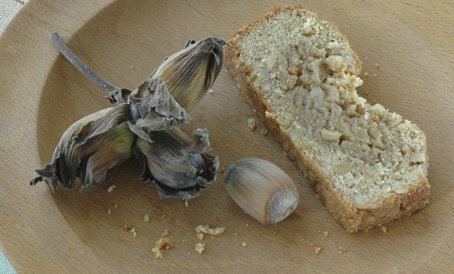
I bought my Kentish cobnuts from Waitrose. I spy them each year, and as far as I know they are the only supermarket to stock them locally. I like the fact that they still have their husks on them. How nice to be able to buy something that hasn't been stripped, sanitised and wrapped in plastic. Duly roasted as per the above instructions, I proceeded with a recipe from 'English Teatime Recipes'.

225g self-raising flour
1 rounded teaspoon of ginger
110g butter (at room temperature)
110g brown sugar
50g Kentish cobnuts, roasted and chopped
1 large egg, beaten

1. Preheat oven to 180C/350F/Gas 4.
2. Grease a baking tin of approx. 9" by 4". I used a loaf tin instead as my shallow (square) tin was too large.
3. Sift flour into a bowl with the ginger.
4. Rub in the butter until the mixture resembles breadcrumbs.
5. Add the sugar and the nut and mix well.
6. Stir in the beaten egg. The mixture will remain fairly dry and crumbly.
7. Put the mixture into the prepared tin and pat down gently with a fork.
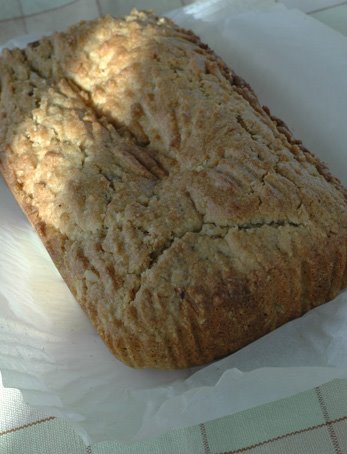
8. Bake for 20 - 30 minutes. I took mine out after 20, but after cutting a slice I put it back in the oven for another 15 mintures. This was because the centre of the cake was very moist looking; however, after further cooking it still looked exactly the same so I concluded that this was how it was supposed to be.
9. If using a shallow cake tin, cut the cake into squares.


The cake has a very loose, crumbly texture - unsurprising considering the appearance of the mixure. Indulgent toppings for your slice of cake might be honey or nutella, alternatively a crisp, sharp tasting apple sliced thinly. A proper Kentish drink to accompany your cake would be a draft of cider - should you have any left over from last time's cake-making...


Check out www.cobnuts.co.uk for other recipe ideas - damson and cobnut mincemeat caught my eye. Make now in time for that only-to-be-mentioned-post-1st-of-December event.

Sunday, September 24, 2006

Seed Cake


Just in time for your harvest supper...

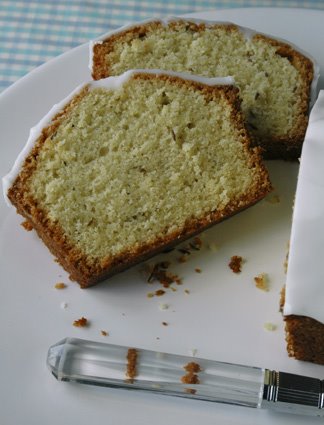
Seed cake is a plain sponge flavoured with caraway seeds, and maybe including some mixed peel. The taste for caraway seeds is perhaps out of fashion now (in the UK at least), but they were once a flavouring much used in cakes, breads, buns and biscuits from the 17th century to the mid-20th.


I have also found that 'seed cake' can be used as a more general term for a cake served at festivals to celebrate the spring sowing of wheat, or to celebrate the autumn harvesting of the crop. Laura Mason writing in the 'Oxford Companion to Food', quotes from a book published in 1892: "Fifty years ago seed-time also had its festival, although on a lesser scale, as well as harvest. At the backend, when the early sowing had been completed, the farmer made a sort of feast for the men, the principle feature of which was 'seed-cake', which was given to each of them. The cake did not get its name from anything that it contains, for in was in fact an ordinary sort of currant or plum cake, but from the occasion." Elizabeth David in 'English Bread' suggests that the caraway seeds were symbolic of the wheat grains sown, and that this would also explain the inclusion of such cakes and breads on the Lenten table (I assume she means eaten to celebrate the end of Lent). One sweetened bread product that included caraway seeds was the wigg - these were eaten with ale and cheese at harvest time, but over time also became a richer, grander bun. For more information on harvest traditions, click here.

Harvest festivals and harvest suppers are traditionally held on the Sunday nearest to the Autumn Equinox (when the hours of daylight equal the hours of darkness). This year the Autumn Equinox is the 23rd of September, i.e. yesterday (and the official start of autumn, nights drawing in etc., but let's not think about that aspect of the season).

Although during my research I came across references to seed cake (all of the caraway variety) made in different regions of the country. The recipes varied very little - some cakes had mixed peel or lemon zest in them, others had solely caraway seeds. I think that seed cake had wide popularity and was baked nationwide, so cannot be attributed to any particular corner of the country.

I have baked seed cake previously from a recipe in Waitrose Food Illustrated magazine. This made a cake similar to madeira cake in buttery richness, and I loved the flavour that the seeds gave to what otherwise would be a very plain cake. I decided to try another recipe this time round, and settled on one from Jane Grigson's ' English Food'. The difference with this recipe is that it includes a small amount of ground almonds, which Jane claims makes the cake 'moist and delicious and most exceptional'! Elizabeth David, not a fan of caraway, had been put off seed cake by dry sponges eaten as a child, and I suspect Jane Grigson may have had similar experiences, hence her delight at finding a recipe resulting in a moist cake.

175g butter
175g caster sugar
3 eggs
1 rounded dessertspoon of caraway seeds
1 level tablespoon ground almonds
250g self-raising flour
A little milk on stand-by

1. Preheat oven to 180C/350F/Gas 4. Prepare a loaf tin.
2. In a large bowl cream together the butter and the sugar. When mix is light and fluffy stir in the caraway seeds.
3. Sift the flour into another bowl and stir in the almonds.
4. Separate the eggs. Whisk the egg whites until stiff, but not too dry looking (you're not making meringues here). In another bowl beat together the yolks. Fold the yolks into the whites.
5. Add a little of the egg mix to the creamed butter and sugar, and a little of the flour. Stir in carefully. Continue to do this until all is blended. If the resulting mixture looks a little dry, add a little milk (I put in about 3 tablepsoons worth).
6. Put cake mixture into the prepared tin, and level the top with the back of a spoon.
7. Bake for about an hour and 5 minutes.
8. Allow cake to cool in tin for 20 minutes before turning out on to cooling rack.


Following a suggestion of my husband's (well, you have to once in a while) I iced the cake with glace icing, but I couldn't help but slip in a little lemon juice so that it had a good citrus kick. I had wanted to use some lemon zest in the cake, so figured that lemon in the icing was a good second option. Actually I felt the that lemon flavour was perhaps too strong ( I used a whole lemon), but it made a good contrast to the flavour of the sponge. The sponge was nice and moist, but I am not sure that the small quantity of ground almonds would make that much difference. The recipe that I have used before didn't contain almonds, and this cake turned out equally well.

A slice of seed cake is good with a glass of madeira, or, equally, a good old-fashioned cup of tea. Here's to autumn - flaming leaves; conkers; hot chocolate on a cold evening; home-made soup for lunch and toad-in-the-hole for tea!

Wednesday, September 06, 2006

Herefordshire Cider Cake


We apparently have the Norman Conquest of 1066 to thank for cider; although maybe it is now a bit late for a 'merci'? The Normans brought their cider making knowledge to the Monasteries and orchards of England. The climate of southern England meant ideal growing conditions for the fruit trees (a replacement for the wine grape vines planted centuries earlier by the Romans). Cider was produced in most of the southern counties, although nowadays it is mainly Kent (in the east) and Somerset and Hereford (in the west) that have kept the tradition. Cider is akin to wine in that the soil, climate and variety of apple used have a bearing on the resulting flavour, and this can vary from harvest to harvest. The main general difference between the ciders of eastern England and the ciders of western England, is that in the east cider-makers tended to use whatever apples were available locally (Bramleys especially), whereas in western England apple varieties were cultivated specifically for cider production.

Cider has seen a rise and fall in popularity over the centuries. With the interest in small-scale production, organic products and traditional foods/drinks, there is currently an upsurge in the drinking of cider and it is fairly easy to purchase a good range of English ciders. During the 18th century cider was looked down upon as a drink of the labouring classes. The gentry didn't want to be supping from the same cup as the country yokel, and they began to drink more of imported wines. It took until the end of the 19th century for an interest in reviving cider production to kickstart the industry in England. Companies such as Bulmers of Hereford, still trading now, were established during this period.

For a more detailed history of cider please click on to this link.

Cider cake was baked as part of the annual cider festival held in Herefordshire, but other cider producing counties also made a version of the cake. All the recipes use baking soda, so the cake must have a fairly recent history (second half of the 19th century). The acidic cider works with the bicarbonate of soda to help the sponge to rise.

I used a genuine Hereford cider, Dunkertons Premium Organic. A medium sweet sparkling cider, made from a blend of apple varieties. Read these names and feel your mouth water. Sheeps Nose, Brown Snout, Foxwhelp Black, Improved Kingston Black and Balls Bitter Sweet. Imagine all that fruitiness condensed into a bottle, and that's the beauty of the drink. With such fizzing flavour I had high hopes for the taste it would bestow on my cake.

My recipe came from the Reader's Digest 'Farmhouse Cookery' recipe book, although I found other recipes that were practically identical save for the quantity of cider used. Reader's Digest used the most, and I thought this would bode well for a nice moist cake.

125g butter, diced
125g sugar
2 eggs, beaten
225g self-raising flour
1 teaspoon bicarbonate of soda
Half teaspoon of grated nutmeg or ground cinnamon (I used half teaspoon of ginger and half of cinnamon, because I like both these spices with apple)
200ml cider
Caster sugar for sprinkling.

1. Preheat oven to 180C/350F/Gas 4.
2. Grease a square, shallow cake tin. Mine was 21cm by 21cm.
3. In a large bowl, cream together the butter and the sugar until light and fluffy.
4. Into another bowl sift the flour, the bicarbonate of soda and the spices.
5. Fold half of the flour mixture into the creamed butter.
6. Add the cider and mix thoroughly.
7. Stir in the remaining flour, and as soon as mixed turn into prepared tin.
8. Bake for about 35-40 minutes.
9. Allow to cool in tin, and sprinkle with caster sugar once turned out.

Pre-sugar sprinkling.


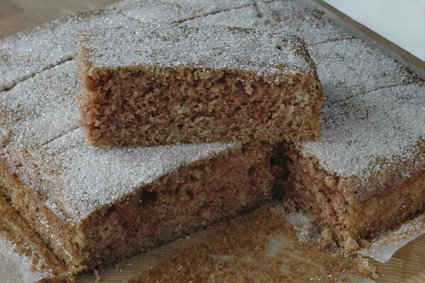
When I divided the cake up I was surprised to see that the inside sponge had a speckled and rosy hue (as if it had had one too many). I think that this may be down to the chemical reaction between baking soda and cider - my food science knowledge is very limited. I liked the effect - rather like the skin of a flecked apple.


The cake was both moist and very light, and the cider flavour was quite distinctive. I mixed some cinnamon powder with my sugar prior to dusting the cake, and I enjoyed the extra kick of spice and sweetness. I have previously made cakes with fresh apple, which I like because of the change of texture that the fruit lends, and also the concentrated sweetness of the pulp. I think a hybrid cake with both cider and apples would also be a fine autumn treat. Get scrumping now...

As a cyclist I have to give a plug for the Hereford Cider Route - navigable by bike (and car if you must) - read more here

Monday, August 28, 2006

Cornish Saffron Cake


Saffron is an ingredient imbued with an air of exoticism, sensuality and beauty. Its musty perfume and concentrated potency both awaken the senses and astonish - how can such a tiny amount of what looks so meaningless release such colour and scent? The labour intensity of harvesting saffron (each stigma removed by hand, 4,300 flowers to be visited to form an ounce of weight), and thereby the cost of the end product, have also added to its status. Stories of Phoenician sailors landing on the rugged Cornish coast to barter with saffron in exchange for tin, have increased its romantic image.

That all said, saffron is a spice not to everyone's taste. For all those that wax lyrical over it, there are also those that consider it a tad overrated. Of course those less impressed may not have sampled the true flavour of saffron. Because of its cost synthetic substitutes or ground turmeric powder are sometimes used in its stead. In the index of Elizabeth David's 'English Bread and Yeast Cookery' is the item 'Saffron, travesties of'. Turn to the page in question and you will be warned to beware 'false, shameful saffron cakes'; these will be made without saffron, only colouring, too much vanilla and sugar sweetening and are sponge cakes, rather than yeasted breads.' Ms. David goes on to give several recipes for genuine saffron cakes - a recipe originating from Devon; a traditional cake from Cornwall; and also recipes from the 17th and 18th centuries which were baked more widely across the country. Not a hint of an E-number or a whiff of shame to be found in these recipes.

Saffron was originally favoured for the lovely bright yellow colour that it imparted to food. It was used liberally by chefs to wealthy mediaeval households for just this effect. Saffron was imported, but some areas of England were able to cultivate it. The cost of 'local' saffron was little less than imported saffron because of the labour involved in producing it. Cambridgeshire and Essex had saffron farms (so too Stratton in Cornwall according to Linda Collister in 'The Bread Book' and Jane Grigson in "English Food' - although I could find no further information on Cornish grown saffron). Saffron Walden in Essex is named for the local trade, although the saffron grown here was principally used for dyeing wool for weaving. The cultivation of saffron in England had all but died out by the 18th century. Despite its growth on the East side of the country it was only in Devon and Cornwall that saffron became associated with a regional food, and both districts developed their own form of fruit bread flavoured with the spice.

Now, at this stage I have to confess that part of the reason that it has been such a long while since I last posted, is that I had
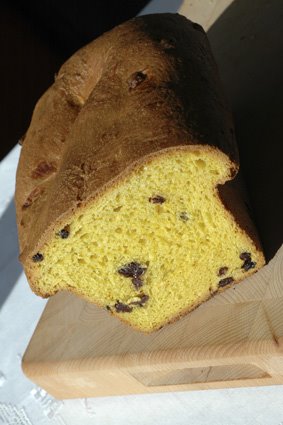
to have two goes at turning out a decent saffron cake. Try number one used the Cornish Saffron Cake recipe from David's 'English Bread etc.', and frankly my loaf turned out to have all the appeal of a house brick. It was edible, but very disappointing. The rise I achieved with the dough was really minimal, despite my incredible patience with it. Patience sorely tried my loaf (after a taste) went binwards. The saffron I used was clearly past its prime, and the loaf was a muted yellow, rather than a proper sun-has-got-his-hat-on golden. I blame myself for the outcome, but, what to do? Browsing through a recipe book at work I found the answer. In Linda Collister's 'Country Breads' book is a recipe entitled 'Daniel's Cornish saffron bread'. I turned to the page expecting to find that Daniel is a Cornish master baker of many years standing. Nope. Daniel is Linda's six year old son, and he bakes a saffron cake each Sunday for tea. Now was the time to swallow my pride (and hopefully a tastier slice of cake), and admit that if a six year old could successfully turn out a saffron cake using this recipe, then there was HOPE FOR ME YET!

I bought myself some fresh saffron, and failing again to find fresh yeast, bought myself a new tin of dried yeast. Unfortunately my mum wasn't around to weigh out my ingredients, nor to negotiate the hot oven, but I thought I might manage this for myself.

Cornish Saffron Bread (so easy even a 33 year old grown-up can make it)

Half a teaspoon of saffron strands
300ml hot milk
500g unbleached white bread flour
1 teaspoon fine sea salt
150g unsalted butter, diced
50g light muscovado sugar
15g fresh yeast/7g dried yeast
100g mixed fruit

Makes one medium sized loaf

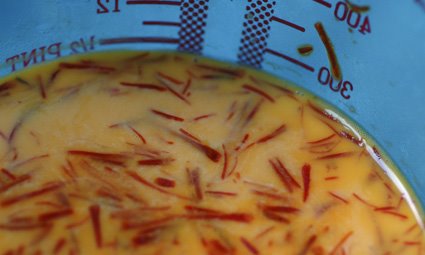
1. Pop the saffron into the hot milk and give it a stir. You will start to see the colour leach from the strands. Glorious. Leave to infuse overnight.


2. Grease a suitable sized loaf tin.
3. Put the flour and the salt into a large mixing bowl. Add the butter, and rub in with fingertips until you get the appearance of fine breadcrumbs. Stir in the sugar until well combined.
4. Reheat the milk to just below blood temperature. With the dried yeast I used I had to use this liquid to get the granules active, and the same applies to fresh yeast. Some dried yeast you can add directly to the flour, so check on the packaging.
5. Make a well in the middle of your flour and pour in the milk and yeast mixture (unless you have added the yeast to the flour - see above).
6. Fun bit. Using your hand work the liquid into the flour to form a dough, and then turn out onto a work surface and knead for 10 minutes. A great early morning workout.
7. Add the dried fruit to the dough (best done in stages) and knead for another minute until well combined.
8. Pop the dough into the greased tin. Put the tin into a large plastic bag (make good use of a nasty supermarket carrier) allowing space for rising, and tuck the opening of the bag under the tin to seal it. Leave the dough to rise to the top of the tin - this will take 1 - 3 hours depending on the kitchen temperature. My dough was ready to bake in 2 hours.


9. Preheat oven to 180C/350F/Gas 4. Bake your loaf for about an hour. The top will be a golden-brown, and the base of the loaf should sound hollow when tapped. Leave to cool on a wire rack.


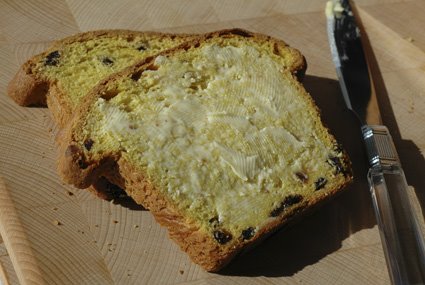
And I am pleased to say that this go at saffron cake making had a happy ending. The dough swelled beautifully, the loaf was a beautiful shade of sunshine, and the crumb was soft and succulent (like a brioche). The saffron flavouring (and scent) was unhindered by the addition of other spices. So, thank you Daniel. You are my new baking mentor.

Monday, July 31, 2006

Scones, Cream and Jam - a West Country cream tea


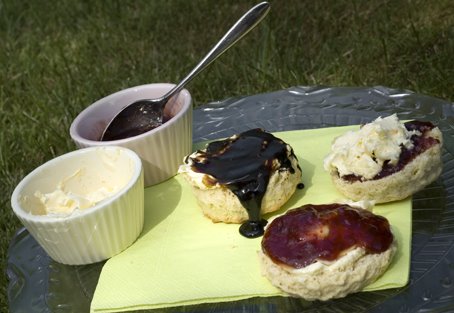
The important question of the day is - do you put cream on first and then jam on top; or do you smother your freshly baked scone with zesty fruit preserve and then top with lashings and lashings of thick, thick cream? If you like cream on top then this means that you follow the Cornish method of anointing your scone; and if you put jam uppermost then you are Devonian in your tastes. The folk of Devon and Cornwall both believe their way of dressing scones is correct and best. I feel a taste test coming on.

Scones in the Devonian manner - cream then jam.

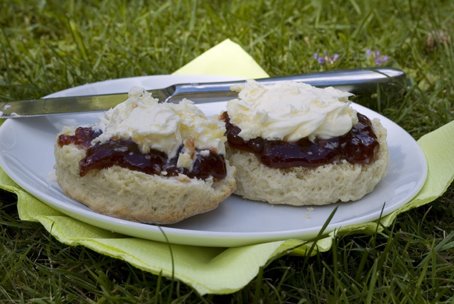
Cornish scones - jam then cream.

Scones - a fundamental part of a West Country cream tea. Cream teas - a fundamental part of English fine food and culinary culture. Who can imagine a finer way to spend a lazy afternoon in the English countryside, than with a jam spoon in one hand, and a smooch of cream on your lips...

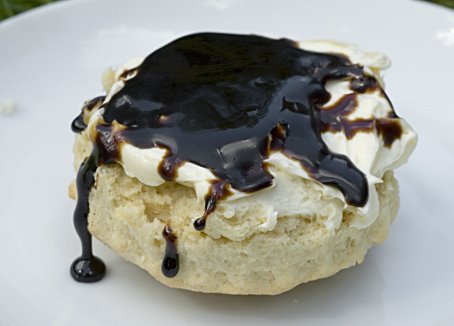
I have previously looked at the history of the scone, and found it to be of Scottish origin. Traditionally cooked upon a gridle or griddle over a open fire. When enclosed ovens and chemical raising agents were introduced in the 19th century, a new generation of scones was born. The Scots baked these new aerated scones and served them as part of their afternoon and high teas. However, other parts of Britain were not slow to also get baking these new-style scones, and in the West of England they were consumed with local products such as clotted cream and fruit preserves. In Cornwall black treacle is also a favoured topping - served along with clotted cream the combination is known as 'Thunder and Lightning'.

Thunder and Lightning - cream with black treacle.

Scones are a favourite food of mine, but I confess it is a good few years since I have made a batch. I can see that good scone baking is a skill that may come with practice, but every scone-mistress or master has had to start somewhere. To give myself an advantage I am following a recipe from Linda Collister's 'The Baking Book'. In the introduction to her scone recipe she writes, '...over the last 20 years I've tried every recipe I've come across [Now, that's dedication] - ones using soured milk or buttermilk; risen with various combinations of bicarbonate of soda and cream of tartar, or baking powder; made with cream, or with golden syrup, with or without eggs.' Twenty years of practice must result in a damn fine recipe? Linda uses self-raising flour (so as to avoid a chemical aftertaste), a pinch of salt, golden caster sugar, butter, an egg and a little milk. Her recipe suggests that you make the dough up in a food processor as this brings the dough together quickly, with the miminum of handling.

230g self-raising flour
a pinch of salt
40g golden caster sugar
40g unsalted butter, diced
1 egg, made up to 140ml with milk

Makes 8 scones when using a 6cm fluted cutter
(might appear to be a modest quantity, but when split and topped with cream and jam this will seem like a feast)

1. Preheat oven to 220C/425F/gas 7.
2. Sift flour and salt into a bowl, then tip into food processor.
3. Add the sugar to the food processor and blend briefly to mix the sugar into the flour.
4. Add the diced butter and pulse until the mixture is lump-free and has the look of sand.
5. Mix the egg and milk together, and then pour into the food processor whilst it is running. You need to keep an eye on the mixture, for as soon as it comes together into a soft ball of dough you need to stop the machine. If dough looks too dry add a little more milk.
6. Remove dough and turn onto floured surface. If the dough is sticky work in a little flour (gently does it). Otherwise, knead the dough carefully - just enough to bring it together into a neater ball, and then pat out on your work surface (use your hands). You need to only press the dough to a depth of about 2cm. Use your cutter to cut out circles of dough. Use the trimmings left to form a second ball of dough, pat out again and then cut more circles.
7. Arrange the circles of dough on a prepared baking tray and pop straight into the oven. Keep an eye on them. The scones should take 12-15 minutes, or should be extracted when they have gone golden brown on top. Put onto wire cooling rack as soon as they leave the oven. Cover with clean tea towel to help keep moistness in.

Scones baked and cooled, I headed out to the garden to conduct some scone sampling.
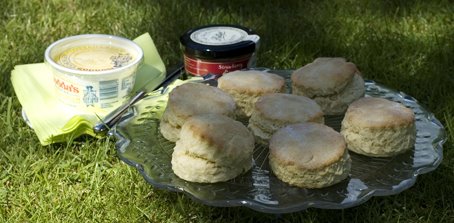
I present the naked scone...


The scones were very light, almost of melt in the mouth crumbliness. This did prove to be a perfect backdrop to the more substantial weight of the cream, and to the more assertive flavour of the jam. I don't think that they were THE ultimate scones, but they were very good (they could have been a little moister I think). As to whether the Devonian or Cornish order of topping was the best, I will have to sit on the fence and say they both work very nicely. However, the black treacle and cream was not for me. You would have to be a real fan of the flavour of treacle to like this as it has such a strong taste.

Which would you choose?...

Gratuitous clotted cream image - one million calories a look.