Showing posts sorted by relevance for query banbury cakes. Sort by date Show all posts

Thursday, May 01, 2008

Banbury Cakes Revisited

Whilst in Deddington, Oxfordshire, and already feeling inspired for my next post (I am obviously on a roll at the moment!), I came across a shop that sold genuine, 100% authentic Banbury Cakes. Banbury is just up/down the road from Deddington. Having previously made these, I bought myself a packet so that I could see how the original compared to the home-baked.


From a visit to the Brown's Original Banbury Cakes website, I was delighted to learn that the current owner/baker, Phillip Brown, is related to Banbury Cake bakers dating back to the early 19th century. He himself is a direct descendent of E.W. Brown who ran 'The Original Cake Shop' from 1868 - her name appears over the door in this photo from 1902. Phillip Brown hand bakes his Banbury Cakes, and they are available for purchase online, and from a select number of shops (including A. Gold in London).

Since I wrote my earlier post about Banbury Cakes I bought Florence White's book 'Good Things in England'. She has a 'modern' recipe (dated 1929) for Banbury Cakes (alongside Gervase Markham's recipe from 1615), that is apparently for the 'same type of cake as those sold by E.W. Brown'. An indiscreet plug for the cakes reads, 'Anyone who wants to buy the best Banbury Cakes ever made can buy them from E.W. Brown, 'The Original Cake Shop', 12 Parson Street, Banbury, Oxfordshire. The recipe given is almost identical to the one that I baked for my Banbury Cakes.


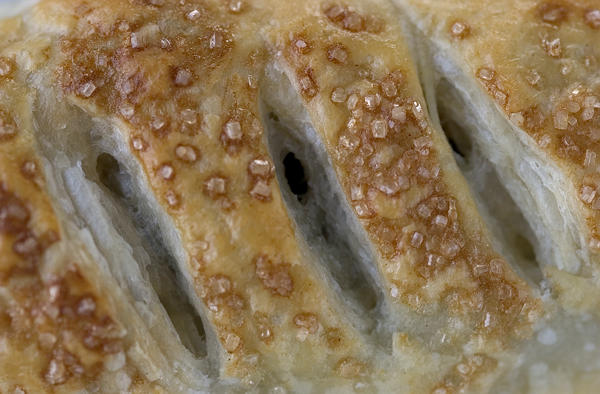
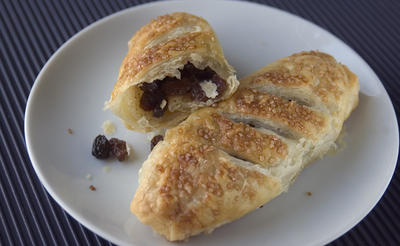
My purchased Banbury Cakes were oval in shape but lacked the three slashes on top that my recipe had instructed I cut (as does the one in Florence White's book). The tops were crusted with sugar, but differed from my efforts in that they were most likely brushed with egg white and then dusted with caster sugar. I used demerara, but this may have been an embellishment of my own devising.

The pastry was, unfortunately, a little travel weary. The Banbury Cakes had only a short excursion in Ellis' changing bag, but this did compress the cakes a little. I felt that the cakes were probably best enjoyed as fresh as possible, and although they had a best-before date of almost four weeks hence, the pastry was a little dry. However, the filling of fruit, spices and sugar was positively fudgy, my only complaint was that there wasn't more of it. All in all I felt my own efforts were pretty decent - certainly in terms of the outer (hmm, to be fair I bought my pastry), and if I were to remake the cakes I would make the fillings with a little more sugar so that they could melt on the tongue in the way Mr. Brown's cakes did.

Sunday, October 23, 2005

Banbury Cakes from Oxfordshire


Banbury, Oxfordshire, may be a familiar place name to those who know the children's verse:

'Ride a cock-horse to Banbury Cross,
To see a fine lady upon a white horse,
With rings on her fingers and bells on her toes,
She shall have music wherever she goes.'

The town still retains its landmark cross, although the Puritans pulled down the original. The cross today stands in the middle of a traffic roundabout, and was erected in 1859 to commemorate the wedding of the then Princess Royal to Prince Frederick of Prussia.

Banbury cakes although not mentioned in the well-known verse, have become just as much of a symbol of the town. They have been made there from at least the early seventeenth century. At one time they were exported to places as far afield as India, Australia and America. A modern local newspaper makes use of the name as its title.

The cake shop in Banbury most closely associated with the cakes for many years was known as The Original Cake Shop, at 12 Parsons Street. The building dated back to the seventeenth century, and this served as a cake shop until it unfortunately fell into disrepair and was demolished in 1968. Also well known was Betts' Cake Shop at 85 High Street, run by a great grand-son of Betty White who set up The Original Cake Shop. See also the second postcard on this page.

There are many recipes for the cakes. The earliest one I could find via the internet is that from Gervase Markham's 'The English Hus-Wife' of 1615:

'To make a very good Banbury Cake, take four pounds of Currants and wash and pick them very clean, and dry them in a cloth; then take three Eggs, and put away one yolk, and beat them, and strain them with Barm, putting thereto Cloves, Mace, Cinamon and Nutmegges, then take a pint of Cream, and as much mornings milk, and set it on the fire till the cold be taken away; then take Flower, and put in good store of cold butter and sugar; then put in your eggs, barm, and meal, and work them all together an hour or more, then save a part of the paste, and the rest break in pieces, and work in your Currants; which done, mould your Cake of whatever quantity you please, and then with that paste which hath not any Currants, cover it thin, both underneath, and aloft. And so bake it according to bigness.'

This recipe would make something closer to an enriched sponge or bread, with a piece of dough containing currants sandwiched between two currant-free pieces of dough. The modern version of the recipe uses puff pastry, and the filling is a mixture of currants, peel and spices. The recipe used today in Banbury town is a secret, but is said to also include rum and brandy. The cakes have a distinctive shape, a pointed oval shape marked with three cuts.


I have to confess that I started off by following what claimed to be the recipe from Gervase Markham's 1615 instructional book (having at that point not seen a transcript of the original), but when I started weighing out the ingredients and I was a bit concerned by the small amount of currants for a 500g weight of pastry, that I went back to the computer to do a hasty bit of extra research. The recipe I had started following is here. If you click on the link you will also see a small illustration of the cakes, which are alongside a specially shaped basket used for transporting the cakes.

So having discovered that the 1615 recipe was not made with puff-pastry (perhaps I should have guessed that?), but having bought said pastry and already rolled it out, I decided to press on with the adapted recipe. I too had to tweak the recipe to work with a slightly smaller quantity of pastry. I used a proportionally larger amount of dried fruit because I didn't want the cakes to all pastry and no filling.

My recipe went like this:

375g puff-pastry
35g melted butter
160g of mixed dried fruit and peel (super handy bag from Julian Graves)
1/2 teaspoon ground allspice
1/2 teaspoon ground nutmeg
1/4 teaspoon ground cinnamon
30g caster sugar (and some demerara for sprinkling)
1 dessert spoon of rum (shamefully I had to use Bacardi)
1 egg white

1. Pre-heat the oven 220C/425F/Gas 7.
2. Dig out a baking sheet and either grease or cover with a non-stick liner (what a great invention).
3. Roll out the pastry thinly (mine was pre-rolled - how lazy is that. In my defense the pre-rolled stuff was on buy-one-get-one-free at Waitrose).
4. Cut into circles. My recipe suggested 18cm/7 inch circles (i.e. draw around a saucer), but that would have used all my pastry up with three cakes. I found a small bowl in the drawer and drew round that. Even so I only managed eight circles.
5. Mix together the butter, dried fruit, spices and sugar, and put a small amount of this into the middle of each circle. Don't get too carried away else the filling will be too big for the cake.
6. Bring up the sides of the circle so that it looks as if you are creating a mini Cornish pasty. Crimp the edges together firmly, and then turn the cake over so the seam side is down. Press down on your cake to flatten it slightly. Put onto baking sheet.
7. When all your cakes are assembled brush with the egg white and sprinkle with the demerara sugar. Cut three slashes into the top of each cake.


8. Bake in the oven for 15 minutes.

The resulting cakes were a pleasing golden colour, and the pastry was very light (I can't take the credit for that unfortunately, but I shopped wisely!). The filling of spiced fruits made me think ahead to Christmas and mince pies hot from the oven, and I felt that I had got the proportion of filling to pastry just right. Some of my cakes had open bellies where my pastry crimping had come loose, which meant the fruit all fell out mid-way to my mouth. If I were to make them again I would keep an eye on this, or eat faster.

Monday, May 19, 2008

Deddington Pudding-Pie, Oxfordshire


Earlier this month I was in Deddington, Oxfordshire. Deddington is a small market town with many interesting old buildings, houses and much history. I was there for a family get-together, so I had little time to explore - only enough for a short walk, and to take two scene-setting photos (taken with one hand whilst straddling a struggling toddler). During my walk I found a shop selling Banbury cakes as per my previous post. The picture below shows the town hall (front left) and the parish church of St. Peter and St. Paul. It also shows how, sadly, many old country towns have become overwhelmed by the motor car. Contrast this (carefully cropped) scene, with the second image. Spot the car park.


Deddington Market Place - image taken between 1860 and 1922
http://viewfinder.english-heritage.org.uk

Historically, Deddington had two annual fairs. One on the 10th of August (St. Laurence's Day) and the other held in November. This latter fair was known as the 'Pudding-Pie Fair' after the pudding- or pudden-pies sold there, and was held principally for the sale of livestock and the hiring of servants/labourers. The date was originally the 11th of November (St. Martin's Day/Martinmas), changing to the 22nd (St. Cecilia's Day), and then reverting back to the 11th of November in more recent times. The Pudding-Pie Fair was still being held at the beginning of the 20th century, but by the 1930s it had diminished and since has evolved into a fun fair. The pudding-pie is now as rare as a Deddington parking space.

The Deddington pudding-pie appears to have been a hard pastry case (the pie) with a pre-cooked filling that included fruit (the pudding), the whole was then baked. Pudding-pies are known elsewhere in the country and often had an association with Lent.

An early mention of the Deddington Pudding-Pie is in 'Notes & Queries' (1869). This records that the pies 'are made by setting up a crust composed of flour mixed with milk or water, and mutton suet melted and poured into it hot. These crusts, which are set up like meat-pie crusts, are then placed in the sun for a day or two to stiffen. They vary in size from about three to four inches in diameter, and are about one inch deep. When thoroughly hard they are filled with the same materials as plum puddings are made of, and when baked are sold at twopence, threepence and fourpence each.'

In the archive of the Deddington News, November 1976, Monica Sansome writes of the Pudding-Pie Fair, drawing on the personal reminiscences of a Mr. Lewis.

From its early days the Martinmas Fair was known as the Pudding-Pie Fair because of the pies made specially for the occasion. Mr. Lewis bought these pies in the early 1900s. They were about the size of a small pork pie, consisting of plum pudding surrounded by pastry. The pastry was made with mutton fat and formed an extremely hard crust "like thick parchment" according to Mr. Lewis, who doesn't remember them as being outstandingly palatable! He thinks they were sold for 2d and 4d depending on size.

Just after 1900 the only bakers in the village to make these pies annually were Thomas and Ruth Fowler. The family had their bakery originally on the premises of Mr. Lewis' shop, then in the Old Bakery, New Street, finally moving to Mr. and Mrs. Beardsley's house next to the Crown and Tuns in New Street... Thomas and Ruth Fowler, like their family before them, guarded the pudding-pie recipe carefully and their recipe died with them.


However, a recipe IS then supplied in this same article, courtesy of Mrs. Ella Marshall who has provided a recipe from 'Traditional English Cooking' (pbl. Angus and Robertson Ltd. 1961) This recipe creates a shortcrust pastry case, but the filling is of cooked ground rice over jam or coconut, and the whole is dusted with ground cinnamon. Quite different to the description of the pudding-pie as a plum pudding in an hardy pastry piecrust.

Shortcrust pastry:
1/2 lb. flour
4 oz. mixed lard and butter
4 tablespoons cold water

To make the filling:
Heat 1 & either 1/2 or 1/4 cups milk (it is impossible to decipher the precise measurement from the original article), add 2 rounded tablespoons caster sugar. Mix 3 level tablespoons ground rice and 1/2 (? same problem) teaspoon salt with 3 tablespoons water. Stir this into the warm milk. Cook and keep stirring until it thickens. Continue cooking "pudden" mixture for a further 5 minutes. Remove from heat. Beat two eggs in a bowl and stir into rice mixture. Flavour with 1/2 teaspoon vanilla essence. Roll out pastry and line greased saucers with the pastry. Cover pastry with jam or dessicated coconut, then pour gently a little of "pudden" mixture over. Bake 20 mins. in medium oven 325F until pastry is cooked underneath. Remove from oven and if liked dust very lightly with ground cinnamon. Nowadays these could be made in an 8" flan about 2"deep. Serve hot or cold.


Born in 1903, Fred Deely, a life-long resident of Deddington, had his boyhood memories recorded by Dorothy E Clarke:

Fred once saw the famous 'Pud', which featured at Deddington's Pudd'n & Pie Fayre, held in November and continued until shortly before the Second World War. It was about 9 inches across, fruit inside, and pastry outside. The lad next to the Three Tuns - Fowler was his name - used to be a baker. He had a sister, Ruth Fowler, she was a cripple, and it was common talk she had the recipe, and when she died nobody ever found it.

Mary Van Turner, in researching 'The Story of Deddington' (1933) spoke with Ruth Fowler, holder of the secret recipe and by this date an elderly lady. From her we learn how the pies were made in the early twentieth century.

Pudding pies have not been made in Deddington for the past six years. Miss Ruth Fowler of 'the Old Bakery', whose family had the original recipe from the Bennetts, who were baking in 1852, undoubtedly made that historic delicacy just as it should be, for in sampling one I found it corresponded exactly with the jesting descriptions which every elder Deddingtonian, including Miss Fowler, delights to give.

'They say you could tie label to one and send it through the post a hundred miles - so hard it was.'

'Deddington folk were supposed to save up all the scrapings from the candle drippings in the lanterns and put them in the pudding pies.' This was also repeated to me by another baker, Mr. W. Course.

Miss Ruth Fowler, herself, quotes a story that gives a quaint, medieval flavour to their peculiar character - a King was journeying from Woodstock to Banbury through Deddington. At Woodstock they gave him gloves and at Banbury light cakes, but in Deddington something between the two, like leather but to be eaten.

Actually they contain a sort of glorified bread pudding in a very hard case. Miss Fowler told me that the outer crust has suet as an ingredient, this is filled with boiled plum pudding, the whole being afterwards baked. Once all the bakers here made them and they were sold at the Stalls. Boiled and baked like Simnel cakes, but with what a different result!


So, according to Mary Vane Turner's account, Deddington pudding-pies have not been made by local bakers since 1927. In the 1970s a version of the 'pudden pie' was baked for the Deddington Festival, held in late summer. In an archived piece from the Deddington News from June 2007, recalling an item from the Deddington Society's Newsletter dated September 1973 and focusing on the Deddington Festival held that month, it was reported that:

The highlight for gourmets at the Festival was the sale of Deddington Pudden pies specially made from a centuries-old recipe by the local baker. The pies, which were made in saucers and sold at the annual Deddington Fair many years ago, have a sweet filling of nuts, ground rice, chopped fruit and eggs and are served with cream. The baker, Mr. B. Wallin, figured in the Festival and a bread book used by his forefathers in the baking trade was displayed in the history exhibition at the parish church.

The pies described here are clearly very different to the robust pies created by the Fowlers and other Deddington bakers at the turn of the twentieth century. They certainly sound more appertising. Curiously, the only other recipe I could find for the pudding-pies is pretty close to the the description of the saucer-baked puddings. I have a sneaky suspicion that the local baker may have seen a copy of Florence White's 'Good Things in England', which is where the recipe I cooked is from. It is here called Deddington Pudden Pie, and although the 'pie' is made of puff pastry, the filling is first boiled and then baked. Perhaps the inedible pastry crust was done away with for the purpose encouraging bakers to revive the pudding.

'A Deddington Pudden Pie was.. made by Miss R. F. Fowler and exhibited at the first English Folk Cookery Exhibition... on January 16th, 1931. The following recipe was published in the Daily News in 1930.

Ingredients: Puff pastry: ground rice 4 oz. [110g]; milk 1 quart [2pints]; eggs 3; lump sugar 6 oz. [175g]; lemon 1; currants 4 oz. [110g]
I baked with half of this quantity of ingredients.

Time: 10 to 15 minutes to boil and 15 to 25 minutes to bake in a moderate oven [180C/350F/Gas 4].

Method:
1. Grease some large saucers and line them with puff pastry.
2. Make the rice into a cream with 6 tablespoons of the milk.
3. Add the eggs well beaten to it.
4. Boil up the remainder of the milk with the lump sugar, and the thinly pared rind of a washed lemon.


5. When this boils add the rice mixture and keep stirring for 10 to 15 minutes; then
6. Lift out the lemon peel, and add the currants.
7. Pour into the lined saucers to within one inch and a half of the edge of the crust.
8. Bake in a moderate oven until the pastry is nicely coloured and the mixture set. They can be eaten hot or cold.


Although Florence White does not say whether she has managed to get Ruth Fowler to divulge her family recipe, I wonder if the recipe she gives, leaving aside the pastry element, is close to it. A 19th century recipe for Folkestone Pudding Pies given by Mrs. Beeton in her 'Book of Household Management'(1861) is so very close to the Deddington Pudden Pie recipe in 'Good Things in England', that I would like to think that Florence White's recipe is authentic. My theory on the rock hard pudding-pie casing is that it was not designed to be eaten, but was to transport the filling home from the fair where it could be consumed. I believe that the pastry casing on the Scottish Black Bun served a similar purpose, keeping the cake from going stale, but intended to be discarded.


I imagined that the 'pudding' would be solid, but it was a cross between a wet cheesecake and a stodgy custard tart (hmm, that will get you all rushing for the kitchen). Maybe I needed to cook the filling for longer, or maybe that was the desired consistency. I baked my pudding-pie for 35 minutes, with another 10 minutes in the oven whilst it cooled - plenty long enough to get a 'set'. Whilst baking the filling rose like a plump Chesterfield, but became the cushion favoured by the dog when it hit cold air. It wasn't unpleasant to eat, just a tad bland and a little too mealy in the mouth for my liking. On the positive side, the currants were nice and juicy and had imbibed the lemon flavouring. Maybe mid Lent or after a hard day flogging cattle it would hit the mark.

Deddington has the most comprehensive and exhaustive website of local information that I have ever come across during my web research. If you have any interest in learning more about the town and its history, then I do urge you to take a good look at www.deddington.org.uk